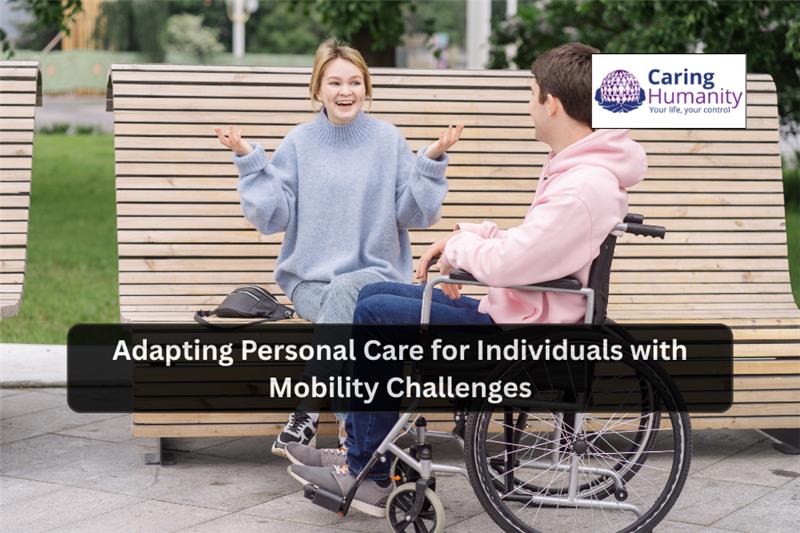
Adapting Personal Care for Individuals with Mobility Challenges  

The challenges of mobility have almost touched upon all aspects of life of an individual. Easy actions such as leaving the bed, administering themselves, cooking, or moving out and about at home safely become harder and even dangerous. People who have disabilities, age-related illnesses, and those in the injury recovery cycle would be questioned or put at risk by using traditional care solutions.

Personal care is supposed to be according to the degree of mobility of an individual. It encourages independence, safety, and dignity. People can conduct their activities and improve their quality of life with the right conditions and having personalised support.

What Is Personal Care and Who Needs It?

Personal care refers to assistance with daily living tasks that are essential for maintaining health, hygiene, and wellbeing. These include:
  • Bathing and grooming
  • Dressing and undressing
  • Toileting and continence management
  • Eating and meal preparation
  • Getting in and out of bed or chairs
  • Moving safely around the home
People who may need personal care include:
  • Individuals with spinal cord injuries
  • People with multiple sclerosis or Parkinson’s disease
  • Stroke survivors
  • Individuals living with cerebral palsy
  • People with age-related mobility issues
In Australia, these services are often accessed through the National Disability Insurance Scheme (NDIS). Under the Core Supports category, “Assistance with Daily Life” provides funding for personalised care delivered at home or in the community.

Why Standard Personal Care Isn't Always Enough

Restrictions in mobility will depend on an individual. There are those who may need quite a bit of assistance and some who will need a lot of help to be able to transfer, to do hygiene, to do mobility. These differences are not taken into consideration in standardised care routines and this may result in:
  • Higher risk of falling or injuries
  • Uneasiness or mental distress
  • The decline of autonomy and self-esteem
  • Poor quality of care
Adaptation of care should entail learning the needs of the person, their preferences and the nature of their home. It needs to be well trained and equipped with the right gear as well as communicated effectively to yield the best results.

Key Components of Adapted Personal Care

Proper personal care of people with mobility difficulties is not just simple support. It needs individual planning, the proper equipment, a secure facility and committed well-trained attendants.

Personalised Daily Routines

The needs and preferences of a person are different. There may be some who need more help in the mornings because they are stiff and some work better in the afternoons because they are alert. The development of a schedule that is consistent with physical requirements, culture beliefs, and behavioral patterns promotes more comfort, independence, and dignity.

Assistive Equipment and Technology

The availability of the appropriate equipment contributes to increased safety and gives individuals an opportunity to be part of their care in case it is possible. Aids like shower chairs, electric beds, transfer hoists and walking aids help alleviate physical limitation of the carer and keep the individual independent. Occupational therapy may recommend those aids which can usually be funded using the NDIS.

Safe and Accessible Home Environments

The quality of care is also critical in terms of carefully arranged home setting. The easy, yet efficient, changes include installing grab rails, having hand held showers, increasing lighting, and keeping walkways clear. Wider ramps and doorways improve the prowess of individuals using mobility mechanisms such as wheelchairs or walkers.

Skilled and Compassionate Support Workers

The trend has been anchored on the support workers involved in providing high-quality care. They may have the responsibilities not only to help in everyday activities but also to take care of them emotionally and make them similar in a human way. With the correct training on expertise on the subject of manual handling, hygiene, using aids to mobility, and proficient correspondence, care is provided with reputable standard and conscientiousness. To develop good trusting relationships, the carers and the clients believing in the same language, culture, or personality can be matched.

Emotional Impact of Personal Care

It may be uneasy or psychologically difficult when one is being taken care of in an intimate manner, particularly when one has compromised mobility. The kind attitude can minimise such perceptions and create confidence. What compassionate care looks like:
  • Taking time to listen without rushing
  • Describing each action prior to doing a task
  • Having eye contact and having a positive body language
  • Trusting privacy evermore
  • Motivating the individual to solve the problem by her or himself
Such care strengthens people and makes them remember that they are not treated as a patient or a client but people.

Accessing Adapted Personal Care Through the NDIS

It is necessary that you can obtain the appropriate personal care assistance with the help of your NDIS plan especially when you have mobility difficulties that are an integral part of your daily routine. You might be an NDIS participant or supporting a person in need of such services, either way here is how it could receive adapted personal care services based on an individual need, and preference:

Step-by-Step Guide:

  1. Review Your NDIS Plan Look under the Core Supports category for Assistance with Daily Life, which covers personal care services.
  2. Speak with Your Support Coordinator or LAC Discuss your personal care, express your personal needs and the support available is out there. Your Local Area Coordinator (LAC) can help you even when you do not have a coordinator.
  3. Request a Care Needs Assessment Daily care needs and mobility issues can be determined by a professional, including an occupational therapist (OT), general practitioner (GP) and allied health worker.
  4. Find the Right Provider NDIS providers who experience mobility support and customised care services registered in research. Research reviews, culture-fit, and adaptability.
  5. Develop a Personalised Care Plan Particular daily activities, any time of day wanted support, assistive devices or equipment. Cultural and personal preferences should also be mentioned in this plan.
  6. Begin Services and Review Regularly As soon as support is provided, check the service to make sure that it is according to your expectations. They should be able to bend and revise personal care plans according to your requirements.
In case the NDIS plan that you already have does not offer you any personal care support, it is possible to request it during the next review of your plan. To support your claims, make sure that you also present your corresponding medical reports, or letters from healthcare representatives etc to solidify your case.

How Families and Carers Can Support the Process

Family members and informal carers play a vital role in making sure personal care adapts effectively. They can:
  • Provide insight into daily routines and preferences
  • Support communication between the participant and support workers
  • Assist in setting up equipment or modifying the home
  • Monitor the quality of care and report concerns
Their involvement helps ensure that personal care is consistent, respectful, and aligned with the person’s goals.

Why Adapted Personal Care Improves Quality of Life

When personal care is adapted to a person’s unique needs, the benefits go far beyond physical assistance. Individuals experience:

  • Greater independence and autonomy
  • Fewer falls or injuries
  • Higher confidence in daily tasks
  • Reduced stress and emotional burden
  • Improved relationships with carers and family
Most importantly, it enables people to live with dignity, on their own terms.

Final Thoughts

The inability to move and walk with ease should never determine the life of a person, making it half, unsafe, and not independent. Personal care adjustments can be a very effective measure to regain confidence and to have an environment that supports the one in the first place.
Given proper training, their software and attitude, support workers and families can provide care that is empowering and not restricting. And through NDIS funding, a greater number of Australians have the freedom to receive high standards of personal care that fits their special needs.
Confused about how to get suitable personal support? We have a specialisation in adaptive, person-first support of people with mobility issues at Caring Humanity. Our team, with many years of experience, closely cooperates with the participants in order to develop individual care plans that support dignity, independence, and comfort.

Leave a Reply